
The Shigir Idol stands as one of the oldest known wooden sculptures ever found, with a mysterious past that continues to puzzle archaeologists and history fans alike. If you enjoy exploring ancient mysteries or just love a good story about old artifacts, this one’s pretty tough to beat. Researchers have been digging deep, quite literally, into its origins, design, and meaning, hoping to piece together what life was like nearly 12,000 years ago in prehistoric Siberia. Here’s everything you need to know about this fascinating wooden monument and its unique ride through history.

The Discovery of the Shigir Idol
The Shigir Idol was accidentally discovered in 1890 by gold miners working in the Ural Mountains of Russia. While digging through a peat bog near Shigir, they stumbled across a strange, massive piece of carved larch wood. At that time, no one really realized they’d unearthed something that would soon become famous across the archaeological world. The idol, measuring more than five meters long in its original state, was taken apart and shipped to a local museum in Yekaterinburg where it started to draw attention for its intricate carvings and mysterious patterns.
For the first hundred years or so, people mostly debated what the idol meant and how old it really was. It wasn’t until 1997 that researchers used radiocarbon dating to estimate its age, which turned out to be around 9,500 years old. Later, updated testing pushed that date back to nearly 12,000 years ago. It’s now considered roughly twice as old as Stonehenge and the Egyptian pyramids.
The initial reaction from the archaeological community was shock and excitement. Finding a wooden artifact of such size and age was unheard of, leading experts from Russia, Germany, and elsewhere to study every inch of the idol. Early museum staff struggled to piece the fragments together, but over decades, researchers managed to restore most of its original form. The interest from international experts has only grown, and today, the idol serves as a point of collaboration among leading scientists looking to unravel more about our ancestors’ creative expressions.
How the Shigir Idol Was Made
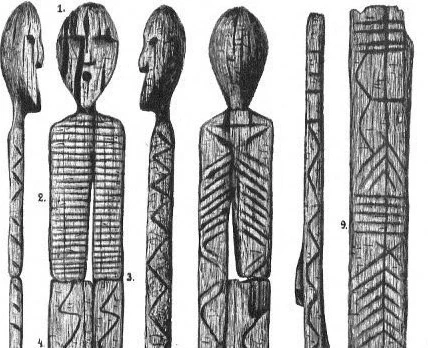
What’s really cool about the Shigir Idol is how it was built. The sculptors carved it from a single trunk of Siberian larch, which is known for its durability and resistance to rot—perfect for surviving in a bog for thousands of years. Using tools made from stone and animal bone, these ancient carvers etched geometric lines, zigzags, and enigmatic faces up and down the figure. Parts of the idol show deep grooves that almost look like woodcut art, showing off a style unlike anything else from that time period.
Standing upright, the idol has a totempole feel, with seven or eight stylized faces running along its body, each one a little different from the last. No one knows for sure what each face or symbol means. Some suggest they represent spirits or ancestors, while others think they mark important stories from the life of the people who made it. The lower body also shows a kind of “body” or “legs” design, although it isn’t quite like any human or animal seen before.
To create these intricate carvings, ancient artisans likely worked cooperatively, passing down knowledge from generation to generation. Some archaeologists note that the precision found on the idol suggests a high degree of craftsmanship and possibly even shared artistic traditions across distant settlements. Though only the Shigir Idol remains on this scale, it’s possible many other such works of art existed, now lost to time as wood is rarely preserved outside bogs and wetlands.
Peat Bogs, Preservation, and Why the Idol Survived
It’s not every day you find a wooden sculpture still kicking after more than ten millennia. What helped the Shigir Idol survive all this time was the bog itself. Peat bogs are super effective at preserving organic materials, like wood, thanks to their low oxygen levels and acidic environment. Instead of breaking down, the wood was kept in near-perfect condition, making it possible for modern researchers to study the original carvings without too much damage or decay.
This environment is a big part of why the idol could be dated so accurately. Unlike artifacts found in open-air settings, which tend to degrade fast, the layers of peat gave archaeologists a clear timeline to track how long the idol had been buried. Between radiocarbon testing and the study of the bog layers, there’s strong evidence putting the idol’s creation right at the end of the last Ice Age, around a time when humans were switching up from huntergatherer groups to early forms of settled life.
What Do the Carvings Mean?
The question of what exactly the Shigir Idol symbolizes is still hotly debated. The carvings cover almost the whole surface, combining geometric motifs and faces in a really stylish and mysterious pattern. Some archaeologists believe the lines could be early attempts at storytelling, sort of a prehistoric comic strip or coded message. The faces sometimes look human, while other features more closely resemble animals.
One theory is that these carvings tell stories about ancient beliefs, creation myths, or important events. Others guess the patterns served as warnings or instructions, maybe a kind of ancient road sign for travelers passing through. Some experts suggest the idol may have had a ritual or spiritual purpose, possibly related to honoring ancestors, nature spirits, or marking territory.
Some recent research points to similarities between the carvings on the idol and rock art found across Eurasia. While no definitive link has been found, these patterns might reflect a shared symbolic language or set of beliefs spreading with early migrations. More research is ongoing, mixing together new technologies like 3D scanning and microscopic analysis to shed light on pigments or tool marks invisible to the naked eye.
Shigir Idol in the Context of Stone Age Art
When most people think about ancient art, cave paintings probably come to mind. The Shigir Idol takes things in a different direction, wood carving instead of rock or stone, and to a massive scale. Unlike the animal hunts and handprints of European caves, the idol’s motifs almost seem abstract, packed full of lines, zigzags, and shapes not found in nature. This suggests the people who made the idol were already dealing with pretty sophisticated ideas about symbolism and ritual.
Given its age, the Shigir Idol challenges a lot of stereotypes about what Stone Age societies could accomplish. It proves that early humans living in Siberia after the Ice Age weren’t just barely surviving. They were expressing themselves deeply and creating art that carried big messages. Researchers also love comparing the idol with ancient stone stelae found in places like Gobekli Tepe (in modern-day Turkey), which share similarities in how abstract designs and faces were used to convey meaning.
The more researchers check out these crosscultural comparisons, the clearer it becomes that ideas traveled rapidly across ancient Eurasia, long before formal writing or lasting settlements appeared.
Challenges, Mysteries, and Controversies
Some of the biggest mysteries about the Shigir Idol boil down to dating and interpretation. When the idol was first studied, estimates for its age swung widely, with debates about whether it was thousands or just hundreds of years old. Improvements in radiocarbon dating cleared up much of the confusion.
The meaning of the carvings is still an open question. While some archaeologists believe they point to burial or ancestor worship, others think the motifs held practical information, such as marking boundary zones or teaching survival skills. With no written language to guide us, researchers need to make careful guesses based on other Stone Age discoveries, but the context for wooden art is quite limited, since wood usually decomposes before it can be studied.
An ongoing challenge is keeping the idol preserved. Changes in humidity, temperature, and exposure to light can all hurt the sculpture, so most of it is kept in special museum cases with limited public access. Only smaller reconstructed sections of the idol are available for regular display, while the more fragile originals are closely protected by conservators. The debate also continues regarding how best to reconstruct the idol visually, as missing fragments mean that some features may be slightly offset from the original artist’s intentions.
Other Wooden Monuments and the Idol’s Uniqueness
It’s rare to find any wooden artifact this ancient, and even rarer to see something this well preserved. While some wooden tools and simple carvings from prehistoric times have survived in waterlogged environments across Scandinavia or Eastern Europe, nothing quite matches the style, scale, or age of the Shigir Idol.
Some minor wooden carvings with geometric decorations have been found in northern Europe, but they generally date from thousands of years later and are less elaborate. The Shigir Idol’s massive size and full-body carvings make it a rare masterpiece—an object that stands apart in the annals of early human creativity. The prestige around the idol has even encouraged Russian authorities to invest in new conservation technology, hoping to slow down the aging process and enable more public access in the future.
Real-World Connections and Cultural Impact
Today, the Shigir Idol stands as a symbol for the creativity and complexity of prehistoric life in Siberia. Visitors to the Sverdlovsk Regional Museum of Local Lore in Yekaterinburg can see the reconstructed idol and learn more about the region’s distant past. For many people, seeing the idol in person is a moment that blurs the line between art and ancient magic. There’s just a primal quality about it that grabs your imagination.
Researchers say the idol challenges how we see “primitive” societies and reminds us that early humans had stories, beliefs, and rituals just as deep as anything we have today. Its discovery and ongoing research have also inspired a bunch of documentaries, history books, and online discussion boards focused on ancient mysteries. School programs in Russia and beyond now highlight the idol as a key example of ancient art, sparking curiosity among young people about history and cultural heritage. Exhibitions about the idol have also traveled internationally, bringing its story to audiences far beyond the Ural Mountains
Final Thoughts
The Shigir Idol isn’t just an old piece of wood; it’s a window into an ancient mind. It shows creativity, talent, and a knack for storytelling from people who lived at the dawn of civilization. Its discovery continues to spark imagination, opening up possibilities for what other secrets may be hiding under layers of time in earth’s bogs and forests. If you’re a fan of ancient wonders, the Shigir Idol is worth adding to your “bucket list” of historical mysteries. The original idol is housed in the Sverdlovsk Regional Museum of Local Lore in Yekaterinburg, Russia. Some sections are on display while the most fragile parts are preserved behind the scenes.